


| "The Last of the America's Log Cabin Statesmen" |
Chuckery, Ohio
 | |  | |  | |  | |  |
| Charles Warren Fairbanks was born on May 11, 1852 in a log cabin near Unionville Center in Union County, Ohio to Loriston Monroe and Mary Adelaide Smith Fairbanks. His father was a wagon maker. Charles Fairbanks was one of ten children. As a child, he attended the local schools. He attended Ohio Wesleyan University in Delaware, Ohio. While there he was the co-editor of the school newspaper. He graduated from Ohio Wesleyan University in 1872. He would later marry his co-editor, Cornelia Cole on October 6, 1874 in Marysville, Ohio. Five children were born to this union. They were Adelaide, Warren, Frederick, Richard, and Robert. His first job after college was with the Associated Press in 1872. He covered political rallies supporting Horace Greeley in Pittsburgh, Pennsylvania during the 1872 Presidential Election. And the seed of his political interests was planted. Charles and Cornelia Fairbanks then moved to Cleveland, Ohio. While in Cleveland, Charles attended law school. He was admitted to the Ohio Bar in 1874. In this same year, the young Fairbanks couple moved to Indianapolis, Indiana. Charles W. Fairbanks' first job in Indianapolis was an appointment as manager of the bankrupt Bloomington, Indianapolis, and Western Railroad. In this capacity he earned $5,000 a year, which was a large sum of money in the 1870s. He later moved on to serve a legal counsel for the Ohio and Chesapeake Railroad. In 1877 he successfully prosecuted striking railroaders, drawing attention to himself from the Indiana Republican Party. In subsequent years, Fairbanks worked tirelessly to rebuild the Republican Party in Indiana. He was successful in this endeavor due to his very strong financial standing in the Indianapolis community and through his many business contacts that he had acquired through his railroad work. The Indiana Republican Party rewarded Charles Fairbanks with a nomination to the US Senate in 1893. However, Fairbanks was not elected. In 1896, Fairbanks was a strong supporter of William McKinley, even speaking on his behalf as the Keynote speaker at the Republican National Convention. This propelled Fairbanks into the national political spotlight. And, he was elected to the US Senate in 1896. As a Senator from Indiana, Charles W. Fairbanks, was appointed to the British Joint High Commission that was to decide the dividing line between Canada and the Alaskan Territory. He has been quoted as saying, "I am opposed to the yielding of an inch of United States Territory." His resolve in this issue drew admiration from the local people in Alaska, and they named a community Fairbanks. This small community now boasts of being one of the largest cities in Alaska. In 1900, some members of the Republican Party tried to persuade Fairbanks to accept the nomination to the office of Vice President. But, Fairbanks instead opted to remain a US Senator. He was also now heavily involved in the newspaper business in Indianapolis. He had a paper, the Indianapolis News. In 1901, this paper purchased the Indianapolis Journal. Fairbanks also thought he could win the Republican Presidential nomination in 1905. But, in 1901, William McKinley was assassinated. Vice President Theodore Roosevelt became the President, and he rather liked the office. He was able to gain the support necessary to gain the Republican Nomination for President in 1905. So, Fairbanks accepted the Vice Presidential nomination. Charles W. Fairbanks served as the twenty sixth Vice President of the United States under the Presidency of Theodore Roosevelt. His term lasted from 1905 to 1908. In 1908, when Roosevelt opted not to seek reelection, instead supporting William Howard Taft, Fairbanks went back to practicing law in Indianapolis. In 1912, Charles Fairbanks returned to the political arena to help develop a platform for the Republican Party. In 1913, his wife Cornelia died. By 1916, he was ready to try again for the Presidential nomination. While he failed in this attempt, he was able to gain the Vice Presidential nomination under Charles Evans Hughes. The election was close in 1916, but Hughes and Fairbanks lost the election to the Democratic incumbents, Woodrow Wilson and Thomas Marshall. Charles W. Fairbanks once again returned to Indianapolis, Indiana to practice law. But, by 1917, his health began to fail. He died in Indianapolis on June 4, 1918 and was buried in the Crown Hill Cemetery. |
| Copyright © 2008 |
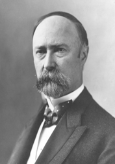
| This is a photo from early in Charles Fairbanks' law career. |
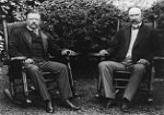
| This photo is of President Theodore Roosevelt and Vice President Charles Fairbanks. |
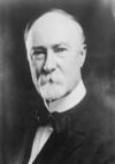
| This picture was taken late in Fairbanks' political career. |